Chasing the Aurora Borealis
Few natural phenomena capture the imagination quite like the aurora borealis, the shimmering curtains of green, pink and violet light that dance across the polar sky. They are caused by charged particles from the sun colliding with Earth's magnetic field and atmosphere, and their intensity rises and falls with the sun's own activity.
Scientists measure this activity using the Kp-index, a scale from 0 to 9 that describes how disturbed Earth's magnetic field currently is. The higher the number, the further south (or north, in the Southern Hemisphere) the aurora typically becomes visible.
Reading the Kp-index
Kp 0-2: Quiet. Aurora mostly confined to the far Arctic/Antarctic.
Kp 3-4: Unsettled to active. Visible from northern Scandinavia, Iceland, Alaska and northern Canada.
Kp 5-6: Minor to moderate geomagnetic storm. Can reach the UK, the Netherlands, Germany and the northern US states.
Kp 7-9: Strong to extreme storm. The aurora can become visible much further south, even at mid-latitudes.
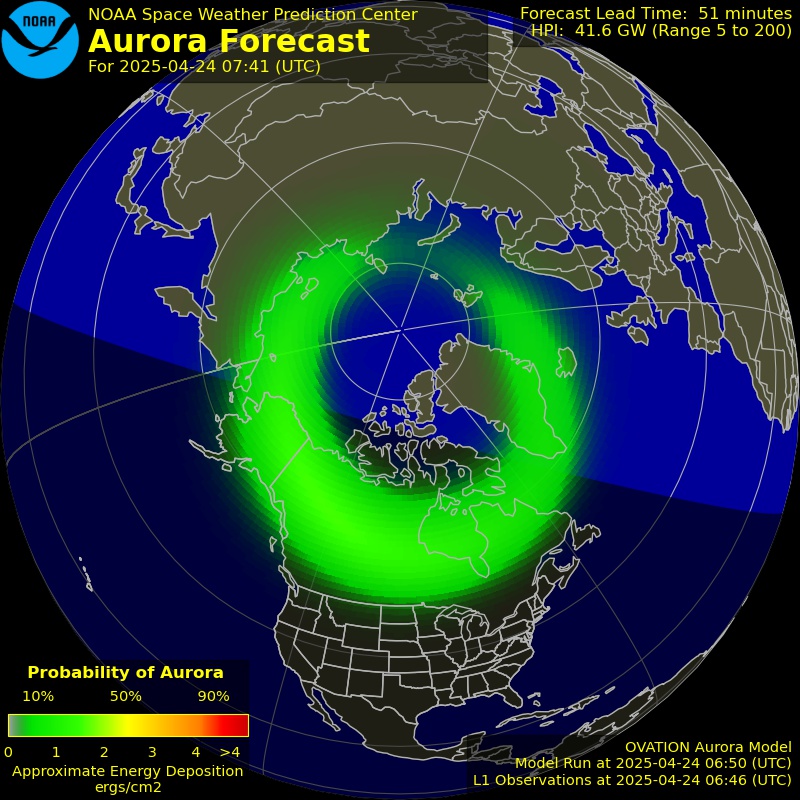
The data below is refreshed live from NOAA's Space Weather Prediction Center, the same public source used by professional aurora forecasters worldwide.
Live Aurora Forecast
Source: NOAA Space Weather Prediction Center
Current Kp-index